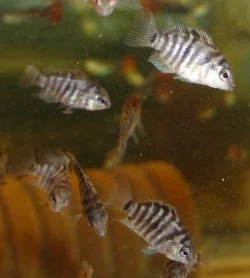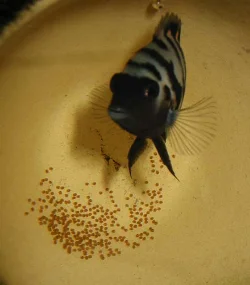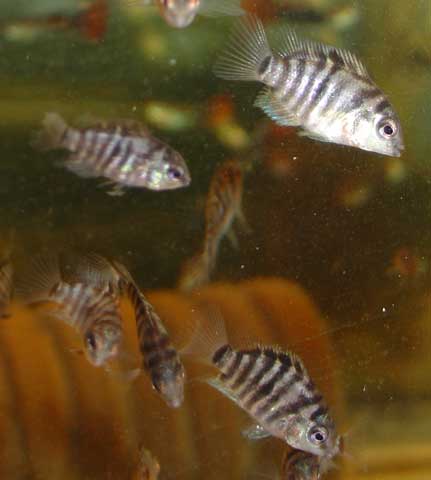
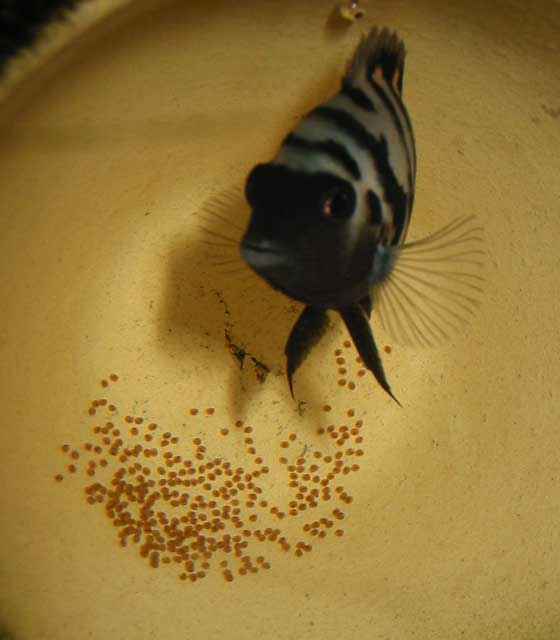
I have kept Convict cichlid several times, also in my very first tank. It was among the first egglaying fish I got fry from and also one of the very few where I managed to raise the fry to adult size. In 2003 I traded a batch of Angels for a very nice couple of convicts, some guppies, some Cryptocoryne aponogetifolia and some cash, and (obviously) they spawned almost instantly and repeatedly. I gave away some of the fry, and traded the rest (about one hundred) for 6 small kribs and a red Zebra female. The Convict cichlid is not an easy fish to sell, primarily because they have lots of fry and people who buy them usually only purchase a couple at a time and they are very resistent against poor care. Don't breed convict cichlids for the money, do it to observe a very interesting parental care for the fry. They are so eager to protect the young that they will even attack the aquarist along with anybody else who dare to breathe near their young. They also like to dig a lot, especially if they don't have a cave, but all those things apart, they are generally a very easy fish to keep.
Naming confusion?
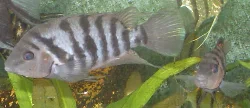
The convict cichlid was earlier called Cichlasoma nigrofasciatum, but then it was first moved to Archocentrus nigrofasciatus and later to Amatitlania nigrofasciata. I have heard several aquarist claim that it was moved again, now to the Cryptoheros genus, but I am unable to find any documentation for that anywhere. In danish it is called "Zebra cichlid" and they can also be found in an albino variant (no red eyes though), called ivory cichlid (at least in danish), but the colour is more pink than ivory. The females of both type have a red spot, especially around their stomach and fins. On some convicts these spots are missing, probably due to poor inbreeding, but generally the convict is a very attractive fish.
Breeding
The convict cichlid is among the very easiest species to breed, if you have a male and a female, they will practically always breed sooner or later. Due to the rather large size difference it is fairly easy to tell the sexes apart as the male is twice as large as the female, but furthermore the male have longer and more pointy fins and the female has red spots on the belly as earlier mentioned.
They usually prefer to spawn in a cave, but in lack of such they will readily spawn in a small hole, dug by the male. The eggs hatch after 2-3 days and the fry start to swim after 6-7 days. They are able to eat freshly hatched artemia from then, but they will also eat all sorts of flake foods if it is small enough - you can crush the flakes between your fingers. Be aware though that the parents become extremely aggressive towards all other tank mates when they have fry and there will be several tough fights over the fry. To avoid this you can remove the eggs from the parents when they spawn, to ensure that they remain somewhat peaceful.