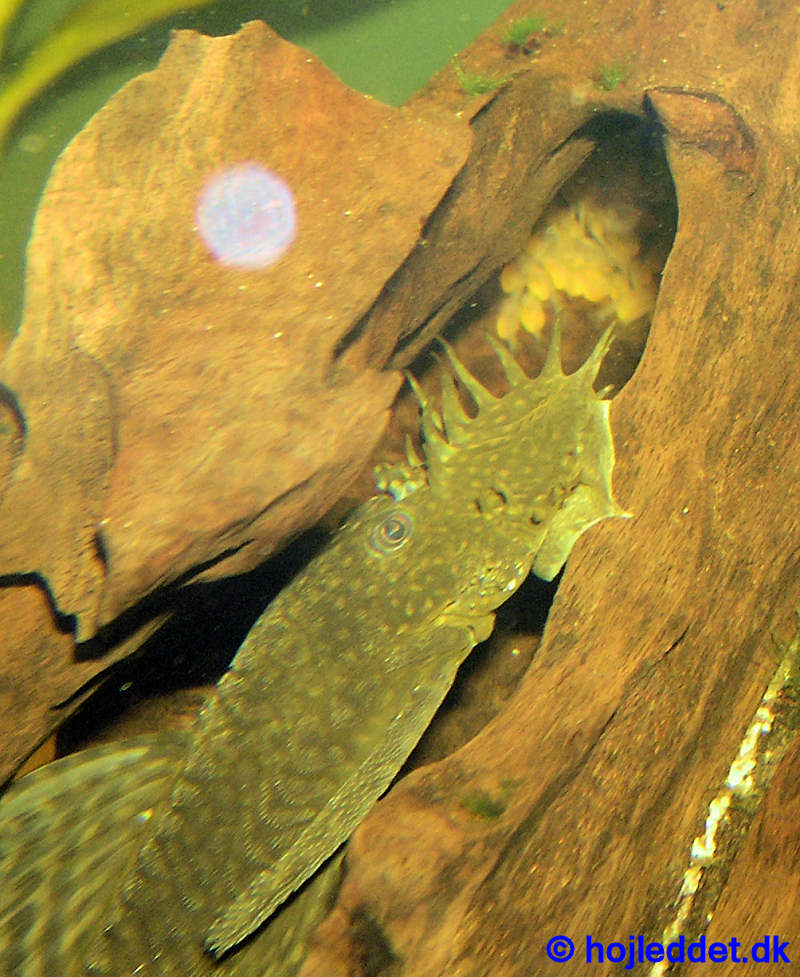

I had never had suckermouth catfish before, but I had to try when I established my new 430-liter aquarium in 2001. I therefore bought 4 from a local breeder, but I didn't have much luck with the first ones, and in total, I have bought about 30, of which I have about half left. I have four males that are breeding, and at least two of them have two or three females.
Food and care
The suckermouth catfish live primarily on green food and are usually extremely effective at keeping the algae population in an aquarium down, but they also like to eat frozen food and they must regularly have catfish pellets or similar to maintain a suitable body condition. It is important that it is possible for the males to find caves where they can hide, and there should preferably also be driftwood in the aquarium, as they rasp wood matter from the roots as an important part of their diet, not least during growth. I have bought a couple of coconuts that I have cracked and put down for them as caves. It should give them more security and encourage spawning, along with varied and heavy feeding. So far, there have been two males who have used one of the coconut caves, while there is another who has used a hole in a tree root and one who has used the underside of a stone. Alternatively, smaller pieces of electrical conduit can also be used, which I don't think looks that good in the aquarium, or you can use bamboo tubes.
Spawning and fry
There is a quite clear difference between males and females, as the males develop some growths by the mouth that look almost like a beard. Ancistrus is not difficult to get to breed, but I have not yet discovered the spawning before there were eggs or fry. I therefore have no certain observations on what has triggered the spawning, but I have an expectation that good body condition (frozen food and green food) and fresh water are instrumental in getting the spawning started. This of course applies to many fish species. The most important prerequisite for breeding Ancistrus is that you have a compatible pair of the same species. It is not as obvious as you might think, as there are a myriad of species within the genus, and they are often sold under the same name. The safest method for getting one or more pairs is to buy 6-10 juveniles from the same litter and let them grow up and pair off.
The eggs are very large and completely orange, and they take about 2-3 days to hatch. It is the male who is responsible for the brood care, and he keeps the fry inside his cave until they are large enough to manage on their own (usually), which is about 5 days after hatching.
The first time I discovered there were fry, there were only 2-3 left. The second time there were quite a few more, which I discovered when I lifted the tree root they lived in out of the aquarium and all the fry swarmed out of the hole. Unfortunately, the other fish in the aquarium snapped up a good portion before I managed to catch about 25 fry. In a later brood, there were about 40 fry I caught and 10 to 20 fry I couldn't catch. It is definitely recommended to let the pair go in an aquarium by themselves or at least with some fish that are less voracious than cichlids if you want the fry to survive.

