

Managing multiple aquariums in a rack system makes filtration a significant challenge. I initially used internal powerheads, but the combined cost of equipment and electricity, along with the weekly cleaning ritual, led me to seek a more sustainable solution.
What is an HMF (Hamburg Matten Filter)?
The HMF is a staple in the hobby for a reason. It utilizes a large surface area of foam to provide both mechanical and superior biological filtration. By using air-driven lifters connected to a single, high-capacity air pump, I can run 11 aquariums simultaneously. This setup is not only energy-efficient but also creates a stable environment for the fish.
While the foam mats might seem like an upfront expense, buying them in bulk or online (e.g., from Maswanord) makes them very cost-effective. These mats act as a breeding ground for nitrifying bacteria, ensuring that harmful nitrogenous waste is processed efficiently.
Materials and Tools
To build your own, you will need: *Filter Mat:** Blue foam (PPI 10 or 20 is recommended). *Airlift:** Electrical conduit (PVC), elbows, and 4mm plastic tubing. *Tools:** Insulation knife or bread knife, a level (as a straight edge), drill (2mm and 5.5mm bits), saw, and a ruler.
Step-by-Step Procedure
Accuracy is key. Measure the internal dimensions of your tank and cut the mat 1-2 mm wider to ensure a tight friction fit against the glass. No silicone is required if the tension is correct.
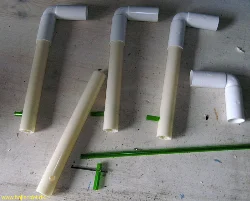
The Riser Tube (Airlift): The lifter should be between 1/2 and 2/3 of the mat's total height. Drill a 5.5mm hole about 2-3 cm from the bottom. Insert a 4mm plastic tube that has been perforated with several 2mm holes. This small modification significantly reduces noise and improves the efficiency of the air bubbles lifting the water.
Installation: You can either cut a groove in the top of the foam or poke the tube through a hole 4-5 cm from the top. Once the mat is wedged in place and the air is connected, the filter is operational.
Maintenance and Longevity
One of the biggest advantages of the HMF is its longevity. These filters can often run for over a year without needing a deep clean. During water changes, simply vacuum the surface of the foam. When it eventually clogs, rinse it in a container of *aquarium water*—never tap water—to protect the beneficial bacteria. My mats have been running for over two years and are still in excellent condition.




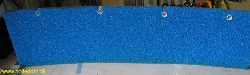
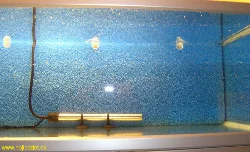
![Full width of the aquarium - normally the filter is mounted on a side wall, but I needed the filter along the back wall. (See the current 100-liter aquarium here)[/akvarium_100l].](/image/thumbnails/00261/300/0)
