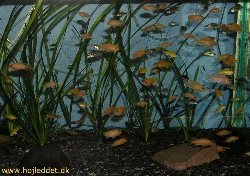
I bought a trio of estherea in February 2002, at the same time I bought my saulosis. As my new esthereas were incredibly shy compared to the saulosis, I chose to sell them again. In December 2003, I got the courage to try them again and bought a pair from a friend.
When I got home with my newly purchased pair, I noticed that the female had something in her mouth, so I put her in a nursery tank and waited, but nothing seemed to happen. After 3-4 days, I decided that I had been wrong and put her back in the main tank. I had a T. placodon that was also carrying eggs and put her in the nursery tank instead, and a day or two later I saw a small fish swimming around while she still had her mouth full. After another couple of days, it dawned on me that it was an estherea fry that had been hiding while the mother was there. It is certainly the smallest brood I have experienced to date!
In January 2004, I traded for another female, so I now have a trio again. My estherea male is the pink variant, but there is also a light blue variant, and among females, there is also an orange blotch (OB) variant where the female has dark spots on a yellow/orange background, as well as a variant where the females are more yellow than orange. I am not a big fan of OB variants in general, so I have never had an OB female myself, and I have not yet seen the yellow variant for sale.
My male and my first female certainly also carry the light blue gene, while my second female (the smallest) has exclusively produced orange fry in the 4 broods she has produced so far. So far, I have had 3 broods from the first female, and the first 2 only totaled 4-5 fry. The latest brood she released on July 22, 2004, consisted of just under 20 fry, and there are 2-3 blue/brown fry among them, which according to what I've read should be males. I also noted that the estherea female takes her fry back into her mouth for several days after they are released for the first time, contrary to what I had gradually become convinced of.