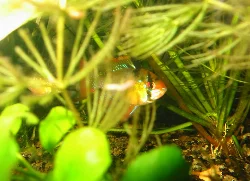
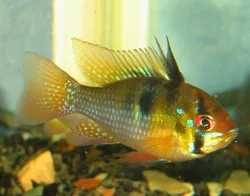
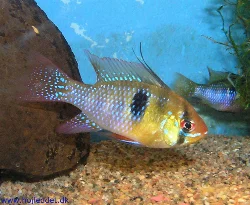
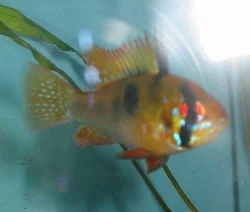
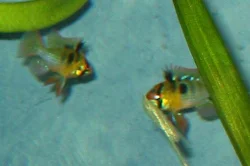
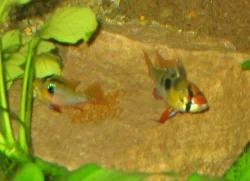
The Ram Cichlid (*Mikrogeophagus ramirezi*) is undoubtedly one of the most beautiful and fascinating dwarf cichlids from South America. With its brilliant blue spangles and prominent dorsal fin, it is a jewel in any aquarium, though it requires specific knowledge of water chemistry and behavior to thrive.
Natural Habitat and Requirements
In the wild, M. ramirezi is found in the Orinoco river basin in Venezuela and Colombia, specifically in the open savanna regions known as Los Llanos. They inhabit shallow, slow-moving streams with dense vegetation. The water here is extremely soft and acidic, with pH values as low as 4.0-5.0 in some areas, and temperatures are consistently high (27-30°C). Success in the aquarium hinges on maintaining pristine, warm water; they are highly sensitive to nitrates and fluctuations in water parameters.
Behavior and Social Needs
Rams are peaceful but territorial during spawning. They form strong pair bonds, and it is a spectacle to watch males displaying to one another with flared fins, which rarely results in actual harm. In a community tank, they coexist well with other peaceful species like Corydoras and small tetras, provided there are plenty of hiding spots among driftwood and plants.
Personal Breeding Experiences
When I first set up my 430-liter tank, I experienced what I call "beginner's luck." Just days after being introduced, a pair laid eggs on a stone. I watched with excitement as the eggs developed into wriggling larvae, but unfortunately, the parents moved them to an unsuitable spot where they fell and were eaten by tank mates.
Since then, I have attempted breeding in both community and dedicated 20l and 54l tanks. A key lesson has been the importance of feeding schedules. During my latest attempt, the pair successfully raised fry to the free-swimming stage on a piece of driftwood. They were exemplary guardians, but I made a critical error: I didn't start my brine shrimp (Artemia) hatchery in time. Brine shrimp should be started no later than 4 days after the eggs are laid to ensure food is ready the moment the fry begin to swim. Sadly, the fry disappeared after a few days—likely consumed by the parents due to hunger or stress.
Rapid Life Cycle
It is impressive how quickly this species develops. Data from experienced breeders suggests that M. ramirezi can reach sexual maturity and spawn as early as 8 weeks of age if provided with intensive feeding (frozen brine, bloodworms, and live daphnia) and frequent water changes. This rapid turnover makes them a dynamic species to work with.