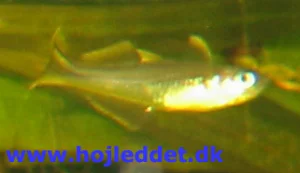
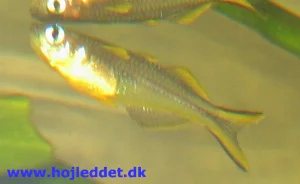
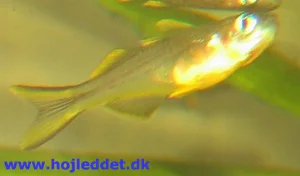
During a visit to the shop 'Planteimporten', I came across this rainbowfish I had never seen before. It was very pretty, and as I was looking for community fish for my 430-liter tank, I took advantage of a '10 for 100 DKK' offer.
Behavior and Habitat
In the tank, they behaved exemplary. Pseudomugil furcatus, commonly known as the Forktail Blue-eye, is an active schooling fish native to the fast-flowing rainforest streams of eastern Papua New Guinea. They swam tirelessly back and forth in the upper layers of the water. I frequently observed the males displaying to the females, flaring their impressive yellow fins in a spectacular courtship dance, though I never witnessed actual spawning.
Challenges and Water Quality
After a while, they began to disappear one by one. Even after moving the final four to a separate tank, the losses continued. Later research revealed that this species is highly sensitive to water quality. They require high oxygen levels and frequent water changes. During a 2-3 month period, I was less diligent with maintenance, and while other species seemed unaffected, it was clearly detrimental to the P. furcatus. They thrive at temperatures of 24-28°C and a pH between 7.0 and 8.0.
Breeding
While I didn't succeed in breeding them myself, they are known as egg-scatterers that attach their eggs to fine-leaved plants or moss. In an aquarium setting, spawning mops are often used. The eggs hatch after approximately 15-20 days. However, as the adults will readily eat their own eggs and fry, a dedicated breeding tank is necessary for successful recruitment.
Status
I highly recommend them as a unique community fish if you are prepared to maintain strict water hygiene. They bring incredible movement and color to the upper sections of the aquarium. I would certainly consider keeping them again in the future.