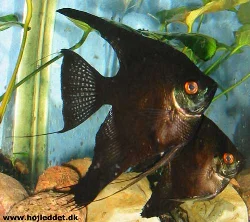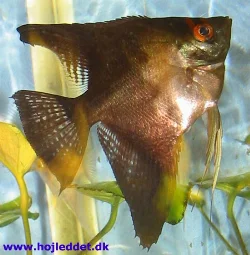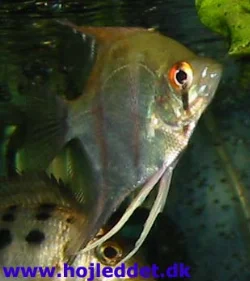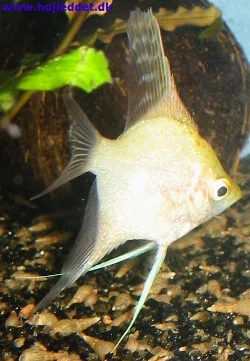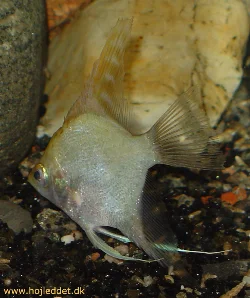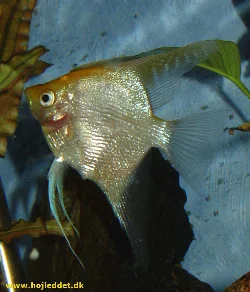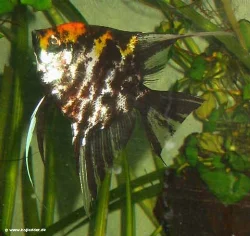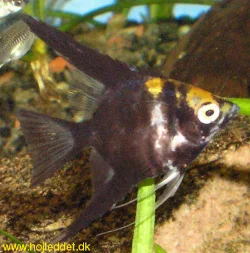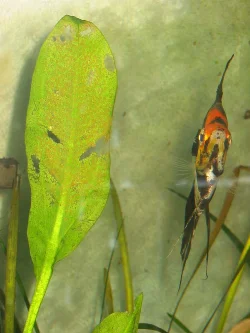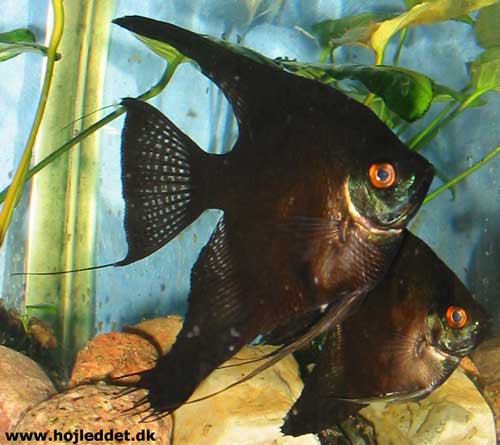
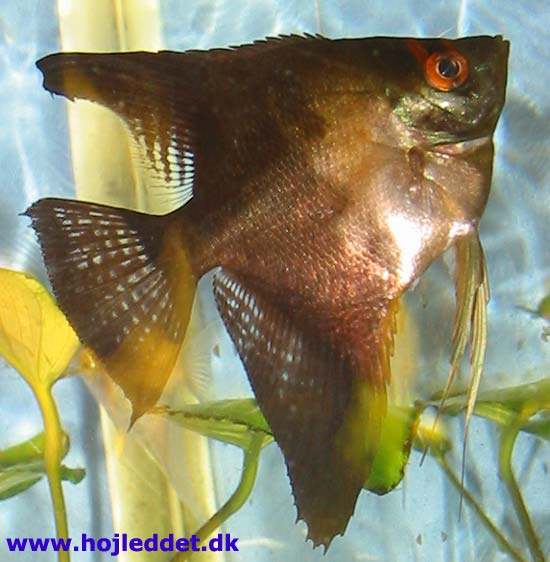
When I resumed my hobby in 2001, I bought 8 small angelfish as one of the first things, which lived in my 430l aquarium. Out of the 8, a pair quickly formed, and a month or two after the first, another one formed. I returned two of the other angelfish once I had the first two pairs and was actually considering how many I should keep.
When I wanted to change my 430l to a Malawi aquarium in the summer of 2002, the 6 remaining angelfish were moved to my 128l. I separated the last two that hadn't formed a pair (presumably two females) and also returned them to the breeder I bought them from.
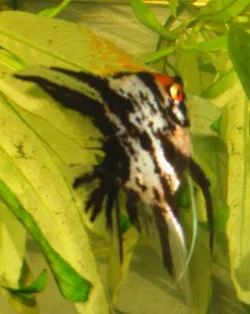
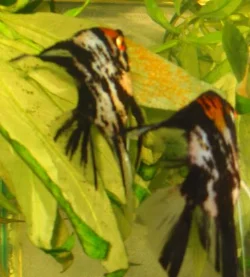
Subsequently, I also sold the last 2 pairs as I only had Malawi cichlids for a period, but now I have bought 6 juveniles again - this time of the variant Pterophyllum scalare Rio Manacapuru. Read more about Pterophyllum scalare Rio Manacapuru (also called "Red back" or "Red shoulder") here.
Breeding angelfish.
It is not difficult to get angelfish to breed if you first have an established pair. The best way to get a pair is by buying between 5 and 8 juveniles and letting them grow up together. From a normal sales size of 5-6 cm, it takes between half a year and a full year before pair formation occurs, but sooner or later a pair will stand out and start preparing a place to lay eggs, probably a leaf or something vertical. When you have a pair, they need to be pampered a bit to get into breeding condition. My two pairs laid eggs regularly if they were fed properly, which means they must have frozen or live food at least once or twice a week. Mine have often spawned the day after they were given red mosquito larvae. In addition to the food, they naturally also need sufficient space to form a territory - when my two pairs were in my 128-liter, it was clear there wasn't enough room, even though they laid eggs regularly (I have experienced 4 spawnings by the same pair within 5 weeks). If you want to keep two pairs, you should not have less than a 250-liter aquarium.
When the eggs are laid, you have two options: either let nature take its course or isolate the eggs in a small aquarium with added fungicide. I tried many times to let the parents take care of the fry themselves, but it never succeeded beyond the hatching stage - then the parents became too tempted and ate the fry.
Artificial breeding.
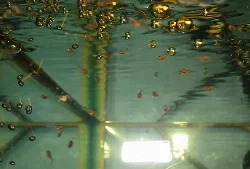
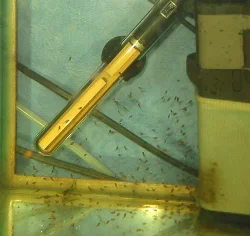
When I wanted angelfish fry, I had no choice but to try artificial breeding in a small aquarium. The first time, I used a small 16-liter aquarium without substrate, where I added some fungicide (Aqua del with fungi-cid), a heater, and a small internal pump with a stocking over the intake. I took the water from the aquarium the parents were in, and the heater was set to the same temperature, around 27-28 degrees. The eggs were on a leaf, which I cut off and placed in the small aquarium on top of a saucer with the stem facing the saucer and the tip of the leaf caught in the cover glass, so the leaf maintained the same angle as before I cut it off. On subsequent occasions using this method, I replaced the internal filter with an air-driven filter instead, as some of the fry perished because they were sucked onto the filter.
Within 2 days, the eggs begin to hatch, and after 3 days, all eggs will normally have hatched. The fry have a form of adhesive on their foreheads, so they stick to the leaf, the saucer, or wherever they land. The hanging period lasts 4-5 days, and about a week after the eggs were laid, the fry are free-swimming.
Only now can you begin feeding! A suitable food is freshly hatched brine shrimp (artemia) which really kickstarts growth in the little ones. They should preferably be fed several times a day, but not too much at once. They require quite heavy feeding to grow optimally, which in turn requires changing 20-25% of the water every other day. It is best if there is no substrate in the aquarium where you raise the fry, so you can vacuum up all food scraps and excrement from the bottom when changing water. A significant advantage of starting hatching in a small aquarium is that you can more easily ensure sufficient food for all fry and thereby ensure somewhat uniform growth, but it requires regular water changes.
The growth of the fry.
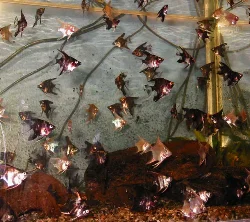
After 3-5 weeks, they must be moved to a larger aquarium - I initially moved them to a 75-liter, and after another 6-7 weeks, they were moved to a 150-liter. Raising angelfish is a delicate balance - it's about keeping them in an aquarium small enough to fill effectively with food, while the aquarium must also be large enough for the fry to grow without hindrance, and at the same time, the water must be changed very frequently to avoid nitrite and nitrate pollution.
On the other hand, I think it's worth all the trouble to see a group of adolescent angelfish darting around the aquarium, and normally you will also be able to sell your fry to pet shops, but the problem you run into is often that you can't sell the fry fast enough. A clutch is typically between 200-500 fry if you remove the eggs, and it requires a very large aquarium to prevent the fry from wearing down each other's fins. It is therefore in your and the fish's interest to cull any weaklings so that you are only left with the finest specimens.
New breeding candidate - a variant of the angelfish from Rio Manacapuru.
In August 2004, I acquired a variant of the common angelfish that is not yet widely distributed, specifically Pterophyllum scalare Rio Manacapuru (also called "Red back angelfish" or "Red shoulder angelfish"). Read more here.