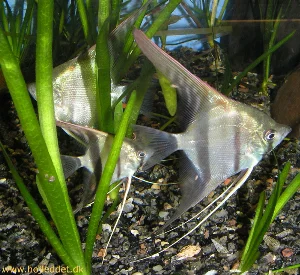
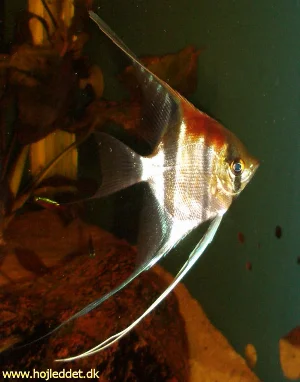
In August 2004, I acquired a variant of the common angelfish that was not yet very widespread, specifically Pterophyllum scalare Rio Manacapuru (also called "Red back" or "Red shoulder" in English). It is a beautiful variant of the classic angelfish with red on top. The breeder where I bought my angelfish in 2001 had some F1s that he breeds from, though without much luck - in about 1.5 years he has only had one brood. From that brood, I bought 6 young angelfish, where he selected 3 of a nice size and 3 small ones to give me a good chance for an equal gender distribution. They can now also be found in a few shops; I have seen them at AkvarieWest and Flyvefisken. The purchase meant that my top 325 liters was converted into a community aquarium for some species I wanted to keep, but which could not go with my Malawi cichlids.
Breeding angelfish.
It is usually not difficult to get angelfish to breed if you first have an established pair. A good way to obtain a pair is to buy 6-8 young angelfish (3-5 cm - at that size they are not that expensive either) and then let them pair off as they grow and become sexually mature. From my six Red shoulder angelfish, a pair formed after a good 9 months, but I actually think the remaining four were two males and two females. It didn't take long from the time they formed a pair until they laid their first eggs - I barely managed to discover their preparations before there was a proper cluster of eggs on the side pane. The first many times the pair laid eggs, I didn't succeed in getting the parents to care for the fry themselves - I haven't been able to judge whether it was because they are bad parents or if they were stressed by the other fish, but in any case, 2 days was the longest period from spawning until the eggs were gone. Otherwise, the pair laid eggs at regular intervals when they received frozen or live food a couple of times a week. To give them peace, I sold the remaining 4 angelfish, but that only caused the pair to start fighting among themselves; the female really took a beating from the male, and I quickly regretted selling the other 4, but by then it was too late.
Artificial breeding.
Tuesday, December 13, 2005, something finally happened again. When I came home from work around 6 PM, I saw the female had her ovipositor out, and they spawned around 7 PM. She laid the eggs on a leaf from Crinum thaianum, but I didn't see if the male fertilized them along the way. Since I really wanted a brood of angelfish fry from my Red shoulders, I had no choice but to attempt artificial breeding in a small aquarium, and I used a small 12 liter aquarium without substrate, where I added some anti-fungal agent (Aqua del with fungi-cid), a heater, and an air-driven filter. I took the water from the aquarium the parents were in, and the heater was set to the same temperature, around 27-28 degrees. I cut off the leaf with the eggs and placed it in the small aquarium with the tip of the leaf clamped in the cover glass, so that the leaf maintained roughly the same slope as before I cut the leaf off. Below is a chronological description of the further progress.
Day 0
I wasn't quite sure if the eggs were fertilized, but I thought I could make out something when I looked at the eggs through my magnifying glass.
Day 1
On Wednesday, not much had happened, except that a handful had gone moldy. I was still a bit unsure if they were fertilized, but it looked as if at least on some of them, development had occurred, but I couldn't see any hint of eyes or the like.
Day 2

When I came home around 8 PM on Thursday, some of the eggs had hatched and several of them had tumbled down to the bottom of the aquarium, where the larvae lay wiggling their tails as best as they could. There were about 50 eggs that had gone moldy, but I did not remove them from the aquarium.
Day 3
The last eggs had hatched when I came home from work on Friday, which matches my previous experiences that hatching starts after two days and is finished after the 3rd day. I removed the leaf and as many of the moldy eggs as I could reach to avoid bad bacteria from them. The larvae have a type of adhesive on their foreheads, so they stick where they happen to land, and they have a tendency to gather in clumps because they also stick to each other. The hanging period usually lasts about 4-5 days.
Day 4
On Saturday, the first larvae began to take short swims, where they lash around for a short time until they land on the bottom again.
Day 5
I don't think the brood will be that large, but there are probably between 50 and 100 fry left, all of which lie wiggling their tails while gathering strength for more of their short swims. About a week from when the eggs were laid, the fry become free-swimming, and it is only now that you should start feeding! To ensure that food is ready for them when it is scheduled to happen on Tuesday, I will set a batch of brine shrimp to hatch as early as Sunday evening.
Day 6
Monday evening, unfortunately, quite a few fry had died - I think there are only about 40 left, but they are, on the other hand, getting ready to swim properly. I removed as many of the dead fry as possible with a pipette.
Day 7
Oh-no-no! Instead of a small shoal of free-swimming angelfish, there were only a few fry still wiggling on the bottom, while most others were dead. I came home quite late today and will take a closer look tomorrow.
Day 8

There are still about 10-12 fry left and they have gradually become free-swimming. I fed a tiny bit of brine shrimp and removed as many of the dead ones as possible.
Day 20
There are only 4 fry left and they are apparently growing - at least they are free-swimming. I only feed with decapsulated brine shrimp, as it is a bit too troublesome to make freshly hatched brine shrimp for such a small brood.
Day 31

Day 34

Day 55

The last 3 angelfish are doing fine and are growing nice and large every day. Normally I would have moved them to another aquarium, but since there are only 3, they manage fine in the small aquarium. I expect, however, to move them within the next 2-4 weeks. As a side note, I can mention that the parents haven't spawned since, which surprises me a bit, but it is probably related to the fact that I moved them to another aquarium.
Raising fry
Freshly hatched brine shrimp is a very suitable food that really kickstarts the growth of the little ones, but you can also use decapsulated brine shrimp eggs, which are a bit easier to handle as they just need to be sprinkled down to the fry. Personally, I prefer the freshly hatched ones, as I believe they also stimulate the hunting instinct of the fry, in addition to them really growing fast. They should preferably be fed several times a day, but not too much at a time. They require quite heavy feeding to grow optimally, which in turn demands changing 20-25% of the water every other day. It is best if there is no substrate in the aquarium where you raise the fry, so you can vacuum up all food remains and excrement from the bottom when you change the water. A significant advantage of starting the hatching in a small aquarium is that you can more easily ensure sufficient food for all the fry and thereby ensure a fairly uniform growth.
The rest of the growth.
After 2 months, it is most common to sell angelfish fry, but the 3 fry were allowed to stay a bit longer with their parents because I was considering making a South American community aquarium, but in the end, I decided to sell them all.
Natural breeding.
It remains my primary goal to experience natural breeding with an angelfish pair, but it will not be with the Rio Manacapuru angelfish, as I have sold both the parent fish and the offspring because they had become too large for a 128-liter aquarium. Once I eventually succeed with natural breeding, I will describe it in more detail here.